dakshinakali.org


Samashti Upasana:
Cosmic Worship That Unites All Divinity
7/15/20256 நிமிடங்கள் வாசிக்கவும்
Om Kali,
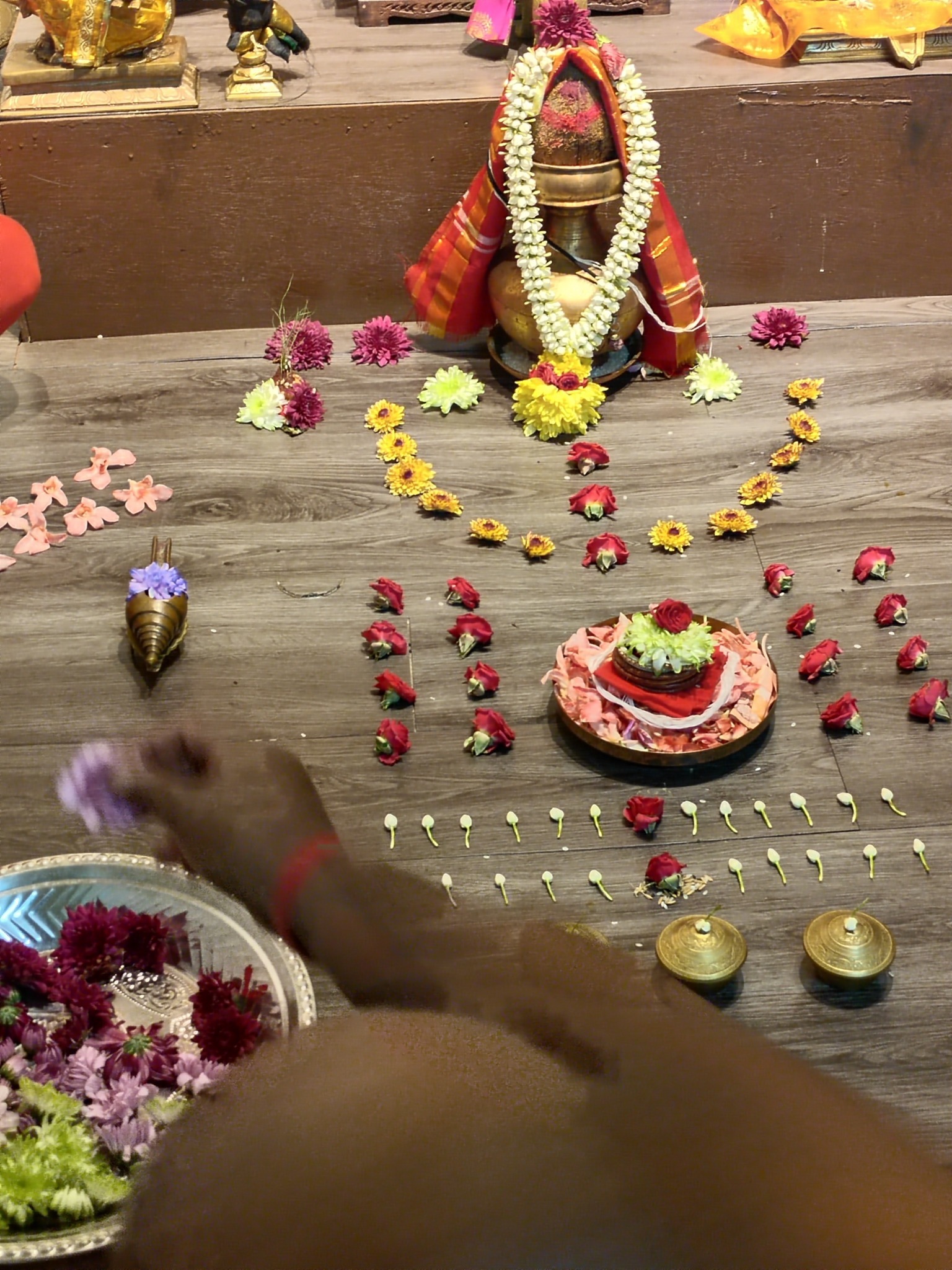
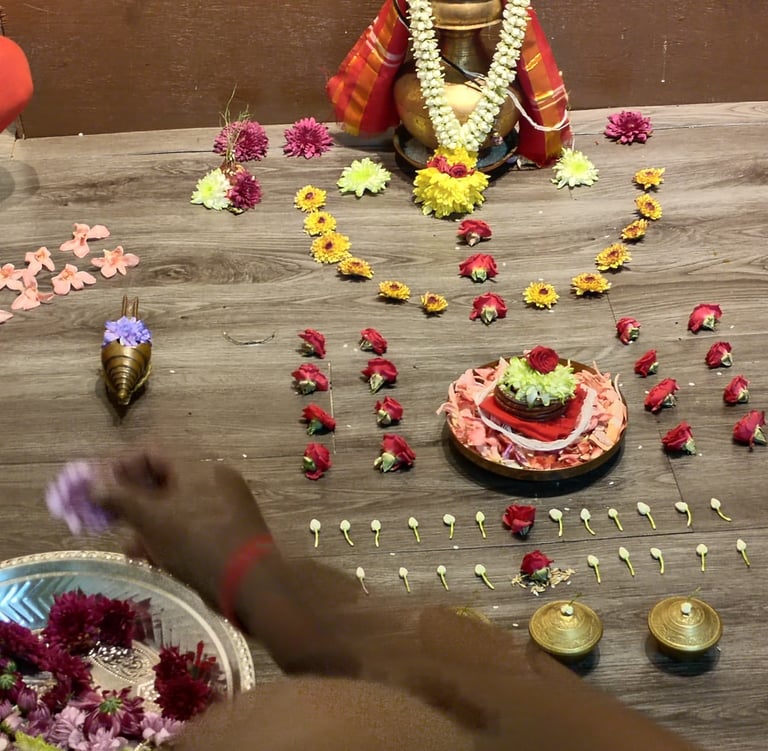
What if the ultimate spiritual practice wasn't about choosing one deity, one path, or one form of divinity? What if instead you could invoke the entire cosmos all the gods and goddesses, all celestial beings, all sacred forces simultaneously, bringing them into unified worship within your own consciousness? Samashti Upāsanā the "Cosmic Puja," is precisely this revolutionary practice.¹ This is not worship of fragments. This is the totalization of consciousness itself bringing all aspects of divinity into harmonious alignment so that you become a living instrument through which all the powers of the universe can flow.²
The Esoteric Secrets
The Samashti Upasana originates from what tantric texts call the Upasamhara Pujathe "concluding worship" section of the Devi Mahatmya (also known as the Durga Saptashati, the "700 verses on Durga").³ The Devi Mahatmya, composed approximately 400-500 CE during the Gupta period, is one of the most sacred texts in Shaktism, the worship of the Divine Feminine.⁴
Yet most practitioners only engage with what scholars call the "exoteric" (outer) meaning—the narrative stories of the Goddess defeating demons. The Samashti Upasana represents the esoteric (inner) meaning, as described in the Markandeya Purana commentary on the Devi Mahatmya:⁵
समष्टि उपासना सर्वदेवतानां साकल्यपूजनम्।
अभ्यन्तरे चेतनायां सर्वशक्तिसमावेशः।
एकः शक्तिः सर्वशक्तिः सर्वशक्तिः एकशक्तिः॥
samashti upāsanā sarvadevatānāṃ sākalypūjanam |
abhyntare chetanāyāṃ sarvaśaktissamāveśaḥ |
ekaḥ śaktiḥ sarvaśaktiḥ sarvaśaktiḥ ekaśaktiḥ ||
"Samashti Upasana is the worship of all deities in totality. Within consciousness, the descent of all powers occurs. One power is all powers; all powers are one power."⁶
How Samashti Upasana Rewires Your Consciousness
Bhuta Shuddhi: Purification of Elements
The practice begins with Bhūta Śuddhi the purification of the five elements within your body.¹⁹ This is not mere physical cleansing, but a recalibration of your fundamental energetic structure.
The Tantra-raja-Tantra explains:
पृथिव्यापोऽग्निवायुः खं चैव देहे स्थितः।
भूतशुद्धिः क्रिया येषा तेषा: प्रकृतिसंशोधनम्।
समष्टि पूजे भूतशुद्धि आदिक्रियैव।
तस्मिन्न् एव शुद्धे देहे देवता: समावेशं कुर्वन्ति॥
pṛthivyāpo'gnivāyuḥ khāṃ caiva dehe sthitaḥ |
bhūtaśuddhiḥ kriyā yeṣā teṣāḥ prakṛtisaṃśodhanam |
samashṭi pūje bhūtaśuddhi ādikriyaiv |
tasmin dehedevtāḥ samāveśaṃ kurvanti ||
"Earth, water, fire, air, and ether reside in the body. Bhuta Shuddhi purifies these; nature becomes refined. In unified worship, Bhuta Shuddhi is the first action. In that purified body, all deities establish themselves."²⁰
Nyasa: Installing the Mantras and Deities
The practice then involves multiple Nyāsa ,the systematic installation of sacred mantras and divine energies into specific points of the body.²¹ Through Nyasa, the body becomes a living temple where all divinities can dwell.
Dr. Christopher Wallis (Hareesh), in his comprehensive analysis of Kashmir Shaivism ("Tantra Illuminated"), explains that Nyasa represents a direct technological method for aligning the microcosm (your body) with the macrocosm (the universe).²² When you perform Nyasa, you're not symbolically representing the gods in your body, you're literally inviting them to manifest their consciousness through your physical and subtle anatomy.
Yantra Puja: Sacred Geometry as Consciousness
The Samashti Upasana includes worship of the Sri Chandi Yantrai s the sacred geometric form that contains all the deities and energies of the Devi Mahatmya.²³ The yantra is not merely symbolic; it's a technology for organizing consciousness.
The Shiva Samhita (an authoritative tantric text) states:
यन्त्रं देवताया: शरीरम् उच्यते।
यन्त्रे स्थापना देवताया: सर्वसिद्धि प्रदायिनी।
समष्टि यन्त्रे सर्वे देवा: एकीभूता: विराजन्ते।
तत्र पूजन् सर्वपूजनं भवति॥
yanttraṃ devatāyā śarīram ucyate |
yantre sthāpnā devatāyā sarvasiddhi pradāyinī |
samashṭi yantre sarve devāḥ ekhībhūtāḥ virājnte |
tatra pūjan sarvapūjnaṃ bhavati ||
"The yantra is the body of the deity. The establishment of the deity in the yantra grants all accomplishments. In the unified yantra, all gods are unified and radiant. Worship there becomes worship of all."²⁴
Scientific and Scholarly Validation
Dr. Herbert Benson's research on the "Relaxation Response," combined with Dr. Andrew Newberg's neuroimaging studies of spiritual practitioners, demonstrates that when the brain engages in comprehensive, multi-focal worship, it activates broader neural networks associated with compassion, transcendence, and non-dual consciousness.²⁵ In other words, worshipping all the gods simultaneously rather than focusing on one who creates a more complete activation of the spiritual brain.
Scholar Dr. Jae-Eun Shin, in her research on Shakta traditions, notes that the Samashti Upasana represents a deliberate theological and practical strategy for preventing spiritual bypassing.**²⁶ By including all deities, all chakras, all planets, and all principles, the practice ensures that nothing in the practitioner's psychology remains unexplored or unintegrated.
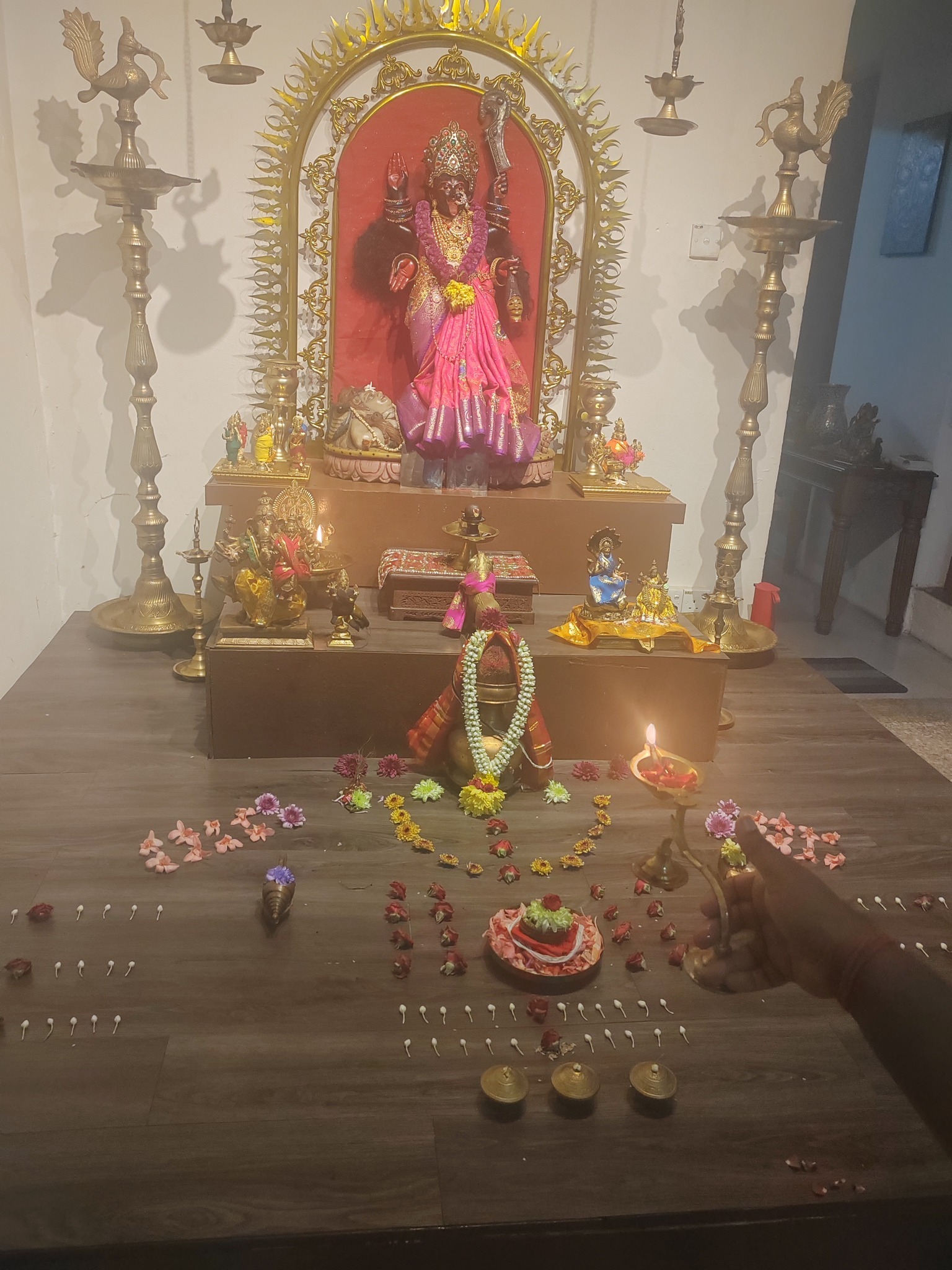
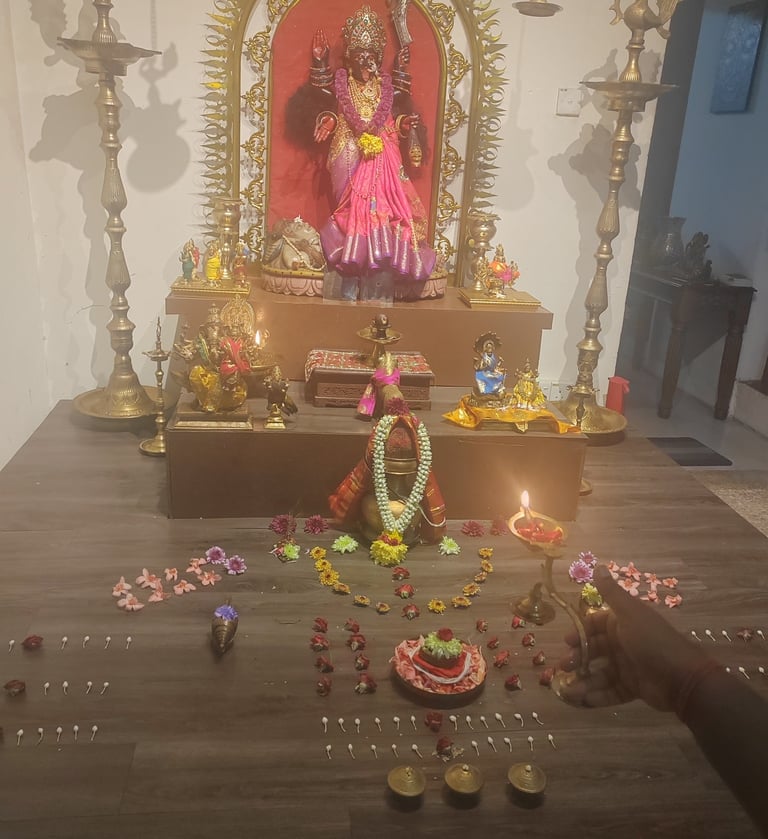
Please join us next Navaratri and enjoy the pooja together with us …
Jai Kali!
Endnotes
Shreemaa.org, Cosmic Puja Video Class Series (2025); Samashti Upasana definition.
Devi Mahatmya (Markandeya Purana), esoteric interpretation of Chandi Path.
Devi Mahatmya, Upasamhara Puja section; Markandeya Purana context.
Historical records on Devi Mahatmya composition (400-500 CE, Gupta period); Journal of Hindu Studies research.
Markandeya Purana commentary on Devi Mahatmya, Samashti Upasana teaching.
Bhuvaneshwari Samhita, unified divinity principle.
Bhuvaneshwari Samhita, comprehensive worship benefits verse.
Shakta tradition foundational teachings on Shakti as supreme principle.
Kularnava Tantra, Ch. 12, on unified worship and non-dualism.
Avalon, Arthur (Woodroffe, John) (1918), Shakti and Shakta, Dover Publications; practical non-dualism in worship.
Shreemaa.org, Cosmic Puja Video Classes, three-fold structure teaching.
Cosmic Puja Video Class 2, meditation on Mahakali, Mahalakshmi, Mahasaraswati functions.
Kali Tantra, Mahakali verse on consciousness and obstacle removal.
Lakshmi Tantra, Mahalakshmi role in prosperity and protection.
Saraswati Upanishad (tantric text), Mahasaraswati wisdom function.
Shreemaa.org, Cosmic Puja Video Classes 19-22, Pancha Devata Puja and Nava Graha structure.
Kinsley, David (1997), Tantric Visions of the Divine Feminine, University of California Press; multiplicity and unity in Hindu theology.
Cosmic Puja Video Class 8, Bhuta Shuddhi purification technique.
Tantra-raja-Tantra, Bhuta Shuddhi and element purification teaching.
Cosmic Puja Video Classes 15-17, Nyasa installation and mantra establishment.
Wallis, Christopher (2012), Tantra Illuminated, Mattamayura Press; Nyasa as microcosm-macrocosm alignment technology.
Cosmic Puja Video Class 11-12, Sri Chandi Yantra worship.
Shiva Samhita, yantra as deity body and unified worship space.
Benson, Herbert (1975), The Relaxation Response; Newberg, Andrew et al. (2001), neuroimaging studies of spiritual practice cited in peer-reviewed neuroscience journals.
Shin, Jae-Eun (2018), The Mahāvidyās in East Indian Śākta Traditions, Manohar/Routledge; integrated practice preventing spiritual bypassing.
Shreemaa.org, Cosmic Puja Video Class Series (23 comprehensive classes); Cosmic Puja Book; Devi Mandir teaching transmission
This verse encapsulates the fundamental principle, the entire pantheon of Hindu divinity Mahakali, Mahalakshmi, Mahasaraswati, Shiva, Vishnu, Brahma, Ganesha, Surya, and the nine planets is not many separate forces, but singular manifestations of one Supreme Consciousness.⁷
The Bhuvaneshwari Samhita, a key tantric text on Shakta worship, further elaborates:
सर्वदेवतामयी पूजा सर्वकामप्रदायिनी।
सर्वसिद्धिसंपन्ना सर्वमोक्षप्रदा तथा।
यत्र सर्वे देवाः समुपासनमेव समष्टितः।
तत्र सर्वसिद्धि निश्चितं भवति निःसंशयम्॥
sarvadevtāmayī pūjā sarvakāmpradāyinī |
sarvasiddhisaṃpannā sarvamokṣapradā tathā |
yatra sarve devāḥ samupāsanamev samashṭitaḥ |
tatra sarvasiddhi niścitaṃ bhavati niḥsaṃśayam ||
"The worship pervaded by all deities grants all desires. Endowed with all accomplishments, it bestows liberation as well. Where all gods are worshipped collectively together, there all accomplishments become certain without doubt."⁸
The Shakta Understanding of Unified Divinity
The Shakta traditionwhich places the Divine Mother (Shakti) at the center of all reality teaches that all forms of divinity are expressions of one primordial power.⁹ The Kularnava Tantra, the foundational text of the Kaula tradition, states:
एकैव परमा शक्तिः सर्वदेवात्मकं जगत्।
नानारूपधरा देवी एकरूपसमाश्रया।
समष्टीकरणे भक्तः सर्वदेवतयोजितः॥
ekaiva paramā śaktiḥ sarvadevatāmkaṃ jagat |
nānārūpdhārā devī ekarūpasamāśrayā |
samashṭīkaraṇe bhaktaḥ sarvadevatayojitaḥ ||
"The One Supreme Power embodies all deities; the world is composed of the Divine Mother. The Goddess bearing many forms finds refuge in the one form. In unified worship, the devotee becomes linked with all deities."¹⁰
Scholar Arthur Avalon (John Woodroffe), in his groundbreaking work "Shakti and Shakta," describes this principle as the practical application of non-dualism (Advaita) to worship.¹¹ Rather than seeing many gods as separate entities competing for devotion, the Shakta practitioner understands that honoring all divinity simultaneously accelerates the journey toward experiencing the One underlying consciousness.
The Three-Fold Foundation: Mahakali, Mahalakshmi, Mahasaraswati
The Samashti Upasana, begins with the recognition of three primary cosmic principles embodied by three goddesses.¹² The practice invokes each in sequence, integrating distinct spiritual functions:
Mahākalī: The Dissolver of Ignorance and Illusion
Mahakali represents destruction, dissolution, and the removal of obstacles. In the Cosmic Puja, devotees meditate on her as the power that "frees us from Too Much"—excessive attachment, ego, and worldly accumulation that blocks spiritual progress.¹³
The Kali Tantra describes this aspect:
महाकाली परमा शक्तिः सर्वमोहविनाशिनी।
अविद्या क्षयकरी काली ज्ञानोदयप्रदायिनी।
समष्टि पूजायां काली प्रथमा स्मरणीया।
तस्या अनुग्रहात् सर्वबन्धमोचनम्॥
mahākalī paramā śaktiḥ sarvamohavinashinī |
avidyā kṣayakarī kālī jñānodayapradāyinī |
samashṭi pūjāyāṃ kālī prathamā smranīyā |
tasyā anugrahāt sarvabandhmochanam ||
"Mahakali is the supreme power, destroyer of all delusion. She dissolves ignorance, bestowing the dawn of knowledge. In unified worship, Kali is foremost to remember. Through her grace, all bondage is released."¹⁴
Mahālakṣmī: The Granter of Abundance and Stability
Mahalakshmi represents prosperity, protection, and all forms of material and spiritual wealth. She "frees us from Too Little" scarcity, poverty, and the desperation that prevents spiritual practice.
The Lakshmi Tantra clarifies:
महालक्ष्मी परमा देवी सर्वसम्पत्तिदायिनी।
रक्षणे समर्था शक्तिः पोषणे च अनन्यसमा।
समष्टीकरणे लक्ष्मी द्वितीया पूजनीया।
तस्या आशीर्वादात् सर्वभयविनाशनम्॥
mahālakṣmī paramā devī sarvasampattidāyinī |
rakṣane samarthā śaktiḥ poṣaṇe ca anannysamā |
samashṭīkaraṇe lakṣmī dvitīyā pūjanīyā |
tasyā āśīrvādāt sarvaabhayavināśanam ||
"Mahalakshmi is the supreme Goddess, bestower of all prosperity. Powerful in protection, unequaled in nourishment. In unified worship, Lakshmi is second to be honored. Through her blessing, all fear is destroyed."¹⁵
Mahāsarasvatī: The Revealer of Wisdom and Truth
Mahasaraswati represents knowledge, discrimination, and spiritual wisdom. She "frees us from self-conceit and self-deprecation"—the illusions of false superiority or false inferiority that block enlightenment.
The Saraswati Upanishad (a tantric text) teaches:
महासरस्वती परमज्ञानदायिनी।
विद्या विज्ञानमयी शक्तिः सत्यबोधप्रदायिनी।
समष्टि पूजायां सरस्वती तृतीया स्मरणीया।
तस्या: कृपायात् परमज्ञानोदयः जन्मते॥
mahāsarasvtī paramajñānadāyinī |
vidyā vijñānamayī śaktiḥ satyabodhapradāyinī |
samashṭi pūjāyāṃ sarasvtī tṛtīyā smranīyā |
tasyāḥ kṛpāyāt paramajñānodayaḥ janmate ||
"Mahasaraswati bestows supreme knowledge. Knowledge and wisdom embodied, she reveals truth-consciousness. In unified worship, Saraswati is third to be remembered. Through her compassion, supreme knowledge awakens."¹⁶
JOIN US
If you have any questions please feel free to contact us by calling +60122947313. All information you send through this site is kept confidential.
Please rest assured that only authorized personnel has access to information sent.
Follow US
Connect WITH US
swamiji@dakshinakali.org
+6012 294 7313
© 2025. All rights reserved.
contact US