dakshinakali.org


The Transformative Power of Ashta Bhairava
A Journey into the Eightfold Flame
5/15/20255 min read
Om Kali,
Across the subcontinent and through the centuries, the Eight Bhairavas (अष्ट-भैरवः ashta-bhairava) remain unmatched as guardians of the sacred, the liminal, and the wild. They are as present in the ancient stones of Kashi as they are in the midnight rituals of Tamil Nadu or the inner workings of the Kaula and Kali Krama lineages. To embrace their worship is to embark on a journey through fear, limitation, and ego emerging liberated, empowered, and whole. Well beyond myth, the Ashta Bhairavas offer a living promise: that through fierceness, tender guardianship, and ruthless compassion, you can transform your life at every level.
From Shiva’s Eye: The Divine Birth of the Bhairavas
When cosmic balance trembled and the arrogance of gods threatened harmony, Shiva created Bhairava from his fiery third eye. This is no mere mythic outburst, it’s a blueprint for spiritual renewal through creative destruction. From Bhairava’s singular energy, eight differentiated powers emerged, each paired with a goddess (Matrika), sworn to eradicate suffering at every level of being.
भैरवाष्टकसम्भूता मातृगणसमन्विताः।
भैरवास्ते सदा पुंसां सर्वदुःखप्रणाशनाः॥
bhairavāṣṭakasambhūtā mātṛgaṇasamanvitāḥ |
bhairavāste sadā puṃsāṃ sarvaduḥkhapraṇāśanāḥ ||
"Born from the Eightfold Bhairava, accompanied by the groups of Mothers, these Bhairavas always destroy every sorrow for all beings."
(Shiva Purana, Vidyeshvara Samhita, Ch. 10, Verse 25)
In these lines, sorrow is not only eased—it is wholly dissolved. Each Bhairava is a light in the darkness, a torch against the encroachment of suffering.
The Mandala of the Eight: The Bhairavas as Guardians of Cosmos and Psyche
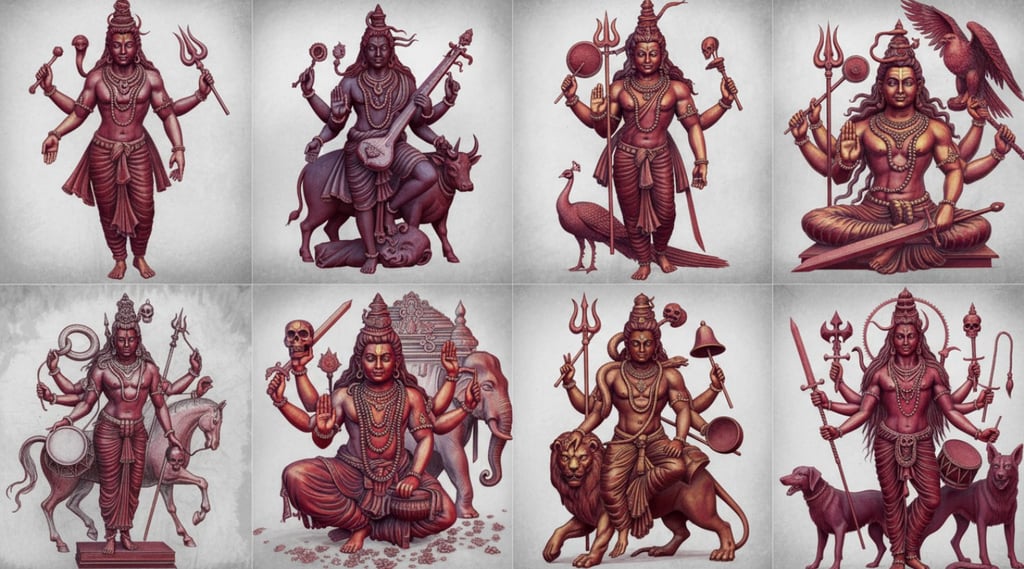
Each of the Eight Bhairavas occupies a cardinal or ordinal direction, signifying guardianship over space, time, and inner transformation. They are:
Asitanga Bhairava
Ruru Bhairava
Chanda Bhairava
Krodha Bhairava
Unmatta Bhairava
Kapala Bhairava
Bheeshana Bhairava
Samhara Bhairava
Each is depicted with his unique vahana, weaponry, and often consort—embodying the fusion of martial protection, wisdom, and nurturing presence. As modern research observes, these forms bridge cosmology, psychology, and daily life.
Gatekeepers of Mystery: Bhairava in Tantric and Kaula Traditions
The Kaula and Kali Krama paths teach that these Bhairavas are not remote deities, but very much alive dynamic powers guarding the innermost thresholds of spiritual practice. To enter the Mother’s secrets, one must encounter, honor, and be transformed by these Eight Lords.
अष्टौ भैरवाः कुलाचार्याः श्रीकण्ठमुखनिर्गताः।
प्रत्येकं शक्तिसंयुक्ताः सर्वकर्मसु तत्पराः॥
aṣṭau bhairavāḥ kulācāryāḥ śrīkaṇṭhamukhanirgatāḥ |
pratyekaṃ śaktisaṃyuktāḥ sarvakarmasu tatparāḥ ||
"The eight Bhairavas, teachers of the Kaula path, emerged from the mouth of Shrikanta (Shiva). Each, united with his Shakti, is intent upon all actions."
(Kularnava Tantra, Ch. 7, Verse 19)
Scholars such as Alexis Sanderson reinforce this: the Kaula Bhairavas are not mere destroyers, they are also initiators, teachers, and healers, standing at the gate of advanced spiritual accomplishment.
Turning Time’s Wheel: Kala Bhairava and the Mastery of Destiny
Why is Bhairava called Kala, the lord of time? Because, as Kala Bhairava Ashtakam glorifies, only by facing time’s truth, change, mortality, impermanence can we be truly free. Time is not to be feared, but ridden.
कालभैरवाय नमः।
भयङ्कराय भैरवाय कालप्रज्ञाय शंभवे।
कालदण्डधरायाशु कालमृत्युविनाशिने॥
kālabhairavāya namaḥ |
bhayaṅkarāya bhairavāya kālaprajñāya śaṃbhave |
kāladaṇḍadharāyāśu kālamṛtyuvināśine ||
"Salutations to Kala Bhairava, the terrible Bhairava, embodiment of time, Shiva Himself, destroyer of death."
(Kala Bhairava Ashtakam, Verse 1)
To worship Bhairava is to look steadily at all we usually flee—and in that gaze, claim true sovereignty over fate.
Living Roots in Tamil Nadu: Bhairava at the Crossroads of Culture
The temple traditions of Tamil Nadu reveal Bhairava not merely as a mythic figure, but as an everyday protector, healer, and friend. Shrines face west or north, and at midnight, Bhairava is honored with offerings, lamps, and even dog-feeding rituals. This living practice persists as a blend of folk devotion and tantric power.
अष्टाक्षरं जपेत्साधुः भैरवस्य यथाविधि।
सर्वसर्वार्थदं पूजा सर्वरोगनिवारणम्॥
aṣṭākṣaraṃ japetsādhuḥ bhairavasya yathāvidhi |
sarvasarvārthadaṃ pūjā sarvaroganivāraṇam ||
"Let the devotee recite correctly the eight-syllable mantra of Bhairava; such worship bestows all good and cures all diseases."
Such practices, as chronicled by field researchers like R. Freeman, demonstrate Bhairava’s role in local healing, protection, and the well-being of families and communities.
Liberating Benefits: Why Seek Ashta Bhairava?
· Conquering Fear, Dispelling Obstacles
Bhakti and sadhana obliterate both unseen and obvious dangers. Bhairava is the ultimate remover of blockages, psychic or material, dissolving the greatest curse: fear itself.
· Mastering Karma, Commanding Fate
Each Bhairava kings over a direction and time—granting the devotee insight, right action, and the ability to harmonize personal destiny with the sacred flow of existence. As the Shiva Purana records:
अष्ट-भैरवाः सर्वगुरवः सर्वप्रेत-गणाधिपाः।
ते ददाति महाशक्तिं संरक्षणे जगत्रये॥
aṣṭa-bhairavāḥ sarvaguravaḥ sarvapreta-gaṇādhipāḥ |
te dadāti mahāśaktiṃ saṃrakṣaṇe jagatraye ||
"The Eight Bhairavas, supreme gurus and lords of all spirits, bestow great power and provide protection to the three worlds."
(Shiva Purana, Vidyeshvara Samhita)
· Healing, Longevity, and Prosperity
Through rituals, mantras, and even simple acts of devotion, the Ashta Bhairavas are credited with removing diseases, extending life, and attracting abundance. "Treating Bhairava's dog with kindness brings blessings and protection for generations," echo both folk wisdom and Agamic text.
Awakening Siddhi and Attainment of Knowledge
The path of the Eight Bhairavas is not only for householders seeking security—it leads directly to spiritual powers and wisdom.
भैरवमुपास्य जातः सर्वविद्यां समश्नुते।
bhairavamupāsya jātaḥ sarvavidyāṃ samaśnute |
"One who worships Bhairava, attains all knowledge."
(Tantra-raja-tantra, Ch. 3, Verse 25)
Tantric initiates receive the Eight Bhairavas as gateways to mantra siddhi and final moksha as each deity bestowing one facet of the sacred totality.
· Integration of Shadow: The Path of Wholeness
Powerful academic voices like Alexis Sanderson and Gavin Flood highlight Bhairava worship as psychological integration. The cremation ground,Bhairava’s abode symbolizes making peace with our most rejected parts, transcending shame, taboo, and limitation.
The Scholar’s Voice, the Seeker’s Testimony
Through field studies and textual analysis, scholars document the dynamic evolution of Bhairava’s cult—showing how it bridges Tantra, temple, village, and psychological renewal. Bhairava worship shapes not only religious landscapes, but emotional lives and communal destinies, uniting lofty metaphysics with humble, heartfelt piety.
Your Own Invitation to Power and Liberation
Amid all the verses, rituals, and scholarship, one truth shines: Bhairava’s circle is always open to those courageous enough to enter. Whether you are called to whisper a mantra in darkness, offer devotion at a temple, or study the inner workings of Tantra, the Ashta Bhairavas empower you to rise beyond fear, ignorance, and fate’s limitations. Take up the mantra, approach the shrine, honor the shadows within and without. The Eight Bhairavas do not barely protect—they initiate, nourish, and shepherd you toward undivided freedom.
May the Eight Bhairavas guard your path, open your heart, and awaken the indestructible light that is your true nature.
Jai Kali!
Endnotes and Sources
Shiva Purana, Vidyeshvara Samhita, Ch. 10, Verse 25.
Flood, Gavin (1996): An Introduction to Hinduism; Freeman, R. (2019): “Bhairava’s Southern Cult.”
Kularnava Tantra, Ch. 7, Verse 19.
Sanderson, Alexis (2007): "The Śaiva Exegesis of Kashmir."
Omnipotent11.com, Thestonestudio.in, Yantrachants.com, and other Puranic/Agamic sources.
Kala Bhairava Ashtakam, Verse 1 (Attributed to Adi Shankaracharya).
Traditional Tamil Bhairava Stotra (oral/liturgical tradition).
Freeman, R., Sanderson, A., and field studies.
Shiva Purana, Vidyeshvara Samhita.
Tantra-raja-tantra, Ch. 3, Verse 25.
JOIN US
If you have any questions please feel free to contact us by calling +60122947313. All information you send through this site is kept confidential.
Please rest assured that only authorized personnel has access to information sent.
Follow US
Connect WITH US
swamiji@dakshinakali.org
+6012 294 7313
© 2025. All rights reserved.
contact US